
Company Formation Switzerland · Switzerland
Company formation in Switzerland from CHF 2,000
Open a Swiss company in Zug, Zurich or any other canton. Create your Swiss Company through local company registration experts.
What do you need?
When deciding to start your company in Switzerland, it is recommended to address a professional team of specialists, as the company formation process has certain particularities explained below. We are prepared to assist foreign businessmen in any of the matters that are involved in the steps of opening a company in Switzerland, regardless of the canton selected for incorporation.
| Quick Facts | |
|---|---|
| What are the types of companies available for registration in Switzerland? | – sole proprietorship, – general partnership, – limited partnership, – private limited liability company, – stock corporation |
Business forms available for foreign companies | – branch office, – subsidiary, – representative office |
Most common business form in Switzerland | Limited liability company (GmbH), followed closely by the stock corporation (AG) |
| Full foreign ownership availability | Yes |
| Company formation steps in Switzerland | – company name check (a name cannot be reserved in Switzerland), – Articles of Association drafting and submission, – bank account opening, – tax registration, – reporting the beneficial owners to the Transparency Register (within one month of registration), – permits only for regulated activities |
| Documents | – ID/passport copies of the shareholder and director, – company Statutes and bylaws, – proof of registered address |
| Company registration fee | CHF 2,000 |
| Notary/Trade Register fee | CHF 1,500 |
| Virtual office service availability and fee | – CHF 1,500 per year for basic packages, – CHF 390/month for basic package + meeting room availability |
| Minimum number of shareholders | One |
| Minimum number of directors | One |
| Resident director required | Yes – at least one person authorised to represent the company (director or manager) must reside in Switzerland |
| Nominee director service availability | Yes, for prices starting at CHF 4,000 per year |
| How long does it take to register a company in Switzerland? | Approx. 4 weeks |
| Remote registration availability (YES/NO) | Yes, through our local agents. |
Which company registration services do you offer in Switzerland and what are your prices?
Our company setup fee starts from CHF 2,000. The following are included in this price:
- Articles of Association and bylaws drafting;
- certified copies of Registration Certificate, bylaws and Statutes for corporate shareholders;
- Trade Register documents submission;
- service manager support during the entire registration procedure.
IMPORTANT!
We also offer assistance in opening a Swiss corporate bank account and share capital deposit for an additional fee;
We also supply virtual office services in Zurich for the price of CHF 1,500 per year or CHF 390 per month (with access to meeting rooms and a local phone number).
Notary and Commercial Register fees are also added to our prices, and they account for approx. CHF 1,500.
You can also watch our presentation video below:

Is full foreign ownership available in Switzerland?
Yes.
What are the types of companies I can set up as a foreigner in Switzerland?
The following:
- sole proprietorship;
- partnerships – general and limited;
- private limited liability company;
- stock corporation.
NOTE: Foreign companies can operate through subsidiaries and branches in Switzerland, if they want to undertake commercial activities. For non-commercial operations, the representative/liaison office is an option.
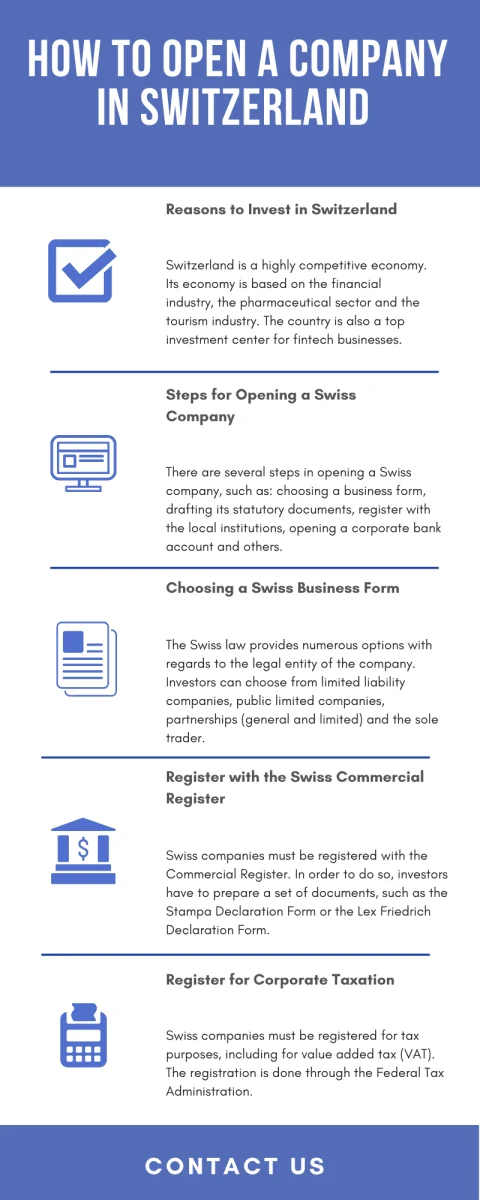
Here is also an infographic on how to start a business in Switzerland:
What are the steps to open a company in Switzerland?
The main steps for opening a company in Switzerland are the following:
- choose the most suitable type of company for your business objectives;
- choose a unique name for the company’s trading name – prepare at least 3 business names for your future company, out of which one will be your trading name;
- open a capital deposit account at a Swiss bank for the company in formation – the capital is paid in here (the full capital of a Swiss GmbH; for an AG at least 20% of each share and at least CHF 50,000), and the bank releases it only after the company is registered;
- draft the articles of association and the public deed of incorporation;
- sign the articles of association and the public deed of incorporation at a public notary in Switzerland;
- fill out, where applicable, the Lex Koller (formerly Lex Friedrich) declaration;
- register your company by submitting all the documents to the commercial register office of the canton where it has its seat; the entry takes effect when it is published in the Swiss Official Gazette of Commerce (SOGC), and within one month the company must report its beneficial owners to the Transparency Register.
What are the documents required for registering a company in Switzerland?
These are the documents and information needed in the process of company formation in Switzerland:
- • the articles of association – the main statutory documents of a local company, which have to be notarized prior to the registration;
- • specimen signatures of every person authorised to sign for the company (board members or managing directors and other authorised signatories), certified or confirmed with a qualified electronic signature;
- • Lex Koller (formerly Lex Friedrich) declaration, where applicable, and information on the registered office of the company;
- • information on the share capital of the company and the main objects of activity that will be conducted through the new legal entity;
- • other documents may be required, depending on the type of business chosen for registration.
What is the most popular business form in Switzerland?
The limited liability company (GmbH), followed closely by the stock corporation (AG).
What is the minimum share capital to start a company in Switzerland?
- CHF 100,000 for a stock corporation (AG), of which at least 20% of the nominal value of each share, and at least CHF 50,000 in total, must be paid in before registration;
- CHF 20,000 for a private limited liability company (GmbH), which must be paid in full before registration.
- Since 2023 the capital can also be set in GBP, EUR, USD or JPY if that currency is needed for the business.
Do I need to appoint a local director for my company in Switzerland?
Yes, at least one person authorised to represent the company (a director or manager) must reside in Switzerland. For this purpose, we offer nominee services starting at CHF 4,000 per year.
Do I need special permits and licenses in Switzerland?
Only for certain activities. Switzerland has no general business licence: apart from the commercial register entry, a permit is needed only in regulated fields, for example financial services supervised by FINMA, medical professions or trades regulated by the cantons.
How long does it take to set up a company in Switzerland?
Approximately one month through our specialized services.
Our Swiss company formation consultants are here to advise and provide qualified consultancy for every entrepreneur wishing to set up his or her Swiss business. We remain at your disposal for any questions you might have, and you can contact our specialists for advice on any matter related to the registration of a business in this country.
Can a foreigner or non-resident set up a company in Switzerland?
Yes. The shareholders of a GmbH or an AG do not have to be Swiss citizens or live in Switzerland, and a single person or company can be the only founder, so a foreign parent can own 100% of a Swiss subsidiary. Directors must be natural persons; a corporate shareholder appoints a person to act in its place.
The Swiss-resident representative rule
One requirement has to be planned from the start: the company must be able to be represented by at least one person who is resident in Switzerland. What counts is residence, not nationality. In an AG this person must be a member of the board of directors or an executive officer (Direktor); in a GmbH, a managing director or a manager. This person must also have access to the share register of an AG or the register of capital contributions of a GmbH, and to the information the company keeps on its beneficial owners.
If no one in your team lives in Switzerland, the usual options are:
- Appoint a Swiss-resident professional as a director or as an authorised manager. We offer this as a nominee director service.
- Hire a manager who lives in Switzerland and give that person signing authority.
- Move to Switzerland yourself. EU and EFTA citizens benefit from the free movement agreement. Other nationals can be admitted as self-employed only if this serves the Swiss economy as a whole and they meet the financial and operational requirements; work permits generally go to managers, specialists and investors or entrepreneurs who create jobs.
The rule applies for the whole life of the company. If the resident representative leaves and is not replaced, the register office sets a deadline to fix the defect and can refer the case to the court, which may appoint someone or, as a last resort, dissolve the company.
Forming the company from abroad
The founders do not have to travel. They can be represented by a proxy when the deed of incorporation is signed; documents issued abroad usually have to be certified and apostilled. Each person who will sign for the company files a specimen signature with the register, certified by a notary or confirmed with a qualified electronic signature recognised in Switzerland.
Should you choose a GmbH or an AG?
Most foreign founders choose between the limited liability company (GmbH, also called Sàrl or Sagl) and the company limited by shares (AG, also called SA). Both have their own legal personality, both can have a single shareholder, and in both the company is liable for its debts only with its own assets. The differences are mainly about capital, ownership changes and privacy.
| GmbH | AG | |
|---|---|---|
| Minimum capital | CHF 20,000 | CHF 100,000 |
| Paid in before registration | The full issue price of every capital contribution | At least 20% of the nominal value of each share and at least CHF 50,000 in total |
| Capital in a foreign currency | Allowed in GBP, EUR, USD or JPY if that currency is needed for the business; at formation it must be worth at least the CHF minimum, and the accounts are then kept in that currency | |
| Management | Managing directors, who must be natural persons; by default all members manage jointly | A board of directors with one or more members |
| Owners shown in the public commercial register | Yes, every member with the number and nominal value of their contributions | No, shareholders are recorded in the company's own share register |
| Transfer of ownership | Written assignment; consent of the members' meeting unless the articles provide otherwise | Registered shares are freely transferable unless the articles restrict transfer |
| Extra payments by owners | The articles may oblige members to make additional contributions, up to twice the nominal value | A shareholder can never be obliged to pay more than the issue price |
| Our setup fee | from CHF 2,000 (notary and commercial register fees extra) | |
The GmbH suits owner-managed businesses and subsidiaries that need little capital and rarely change owners, but its members appear by name in the public register. The AG needs more capital, yet makes it easier to bring in investors, transfer shares and keep shareholders out of the public register; it is also the usual form for holding companies. In both, the beneficial owners are reported to the non-public Transparency Register.
What the 2023 company law reform changed
- Foreign currency capital: capital may be set in pounds, euros, US dollars or yen when that currency is needed for the business.
- Capital band: the articles of an AG can authorise the board, for up to five years, to raise or cut the capital within 50% above or below the registered amount.
- Flexible general meetings: if the articles allow it, meetings can be held abroad or purely online; resolutions can also be passed in writing, on paper or electronically, unless a shareholder asks for an oral debate.
- Interim dividends based on interim accounts, and nominal values that only need to be greater than zero.
How does company formation in Switzerland work, step by step?
- Choose the legal form and the seat. The seat is a Swiss municipality and decides which canton's commercial register and tax rules apply.
- Check the name. The name must show the legal form and be clearly different from every company name already registered in Switzerland. A first check can be done for free on the federal Zefix database; the Federal Commercial Registry Office also offers a search for identical and similar names for CHF 50. A name cannot be reserved: it is protected only once the registration is published.
- Prepare the articles and the people. The articles state at least the name, seat, objects, capital and its currency, the shares and how the company communicates with its owners. You also decide who will be director, who will sign, and whether to appoint an auditor or opt out.
- Pay in the capital. Cash goes into an account for the company in formation at a Swiss bank, which confirms the deposit and releases the money only after registration. Contributions in kind need a written contract, a founders' report and an auditor's confirmation.
- Sign the deed of incorporation before a Swiss notary. In this public deed the founders declare that they are forming the company, adopt the articles, subscribe for the shares and appoint the directors.
- File with the commercial register. The application goes to the commercial register office of the canton where the company has its seat, with the deed, the articles, the directors' acceptance of office, the bank confirmation and, if the company uses a c/o address, the declaration of the domicile provider.
- Entry and publication. The company acquires legal personality when it is entered in the commercial register, and the entry takes effect when it is published online in the Swiss Official Gazette of Commerce (SOGC).
- Report the beneficial owners. Since 1 October 2026, a new company must report its beneficial owners to the Transparency Register within one month of registration. If all of them already appear in the commercial register as members or officers, the report can be filed through the cantonal register office instead.
In our experience the process takes about four weeks; most of the time goes into certifying documents from abroad, the bank's checks and the notary appointment. There is no general business licence in Switzerland: a permit is needed only for regulated activities, for example a FINMA licence for financial services, or for professions regulated by the Confederation or the cantons.
Does a Swiss company need an address in Switzerland?
Yes. Besides the seat, the commercial register records a legal domicile: the street address where the company can be reached. It can be the company's own office or someone else's address, a so-called c/o address. For a c/o address, the provider signs a declaration that it grants the company a domicile, filed with the registration. If an address looks like an undeclared c/o address, the register office asks for this declaration or for proof of own premises, such as a lease.
- The address decides the tax rate. Cantonal and communal taxes depend on the municipality of the seat.
- The domicile must stay valid. A company no longer legally domiciled at its seat has an organisational defect that shareholders or creditors can take to court, so keep any domicile agreement in force and update the register when you move.
- Real management matters for tax. A company is taxed in Switzerland if its seat or its effective management is there. If the decisions are actually taken in another country, that country may also treat the company as resident, so plan where the board meets and where decisions are made.
For founders who do not need their own office, we provide a virtual office in Zurich for CHF 1,500 per year, or CHF 390 per month with access to meeting rooms and a local phone number.
How are companies taxed in Switzerland?
A GmbH or AG pays profit tax to three levels of government: the Confederation, the canton and the municipality. The canton assesses and collects the federal tax as well, so the company files one annual tax return with the cantonal tax administration.
- Federal profit tax: 8.5% of net profit, the same in every canton. Because taxes are deductible expenses in Switzerland, this corresponds to about 7.8% of profit before tax.
- Cantonal and communal profit tax: each canton sets its own rates and each municipality its multiplier, so the total depends on the seat. The federal SME portal, citing the Swiss Tax Report 2025, gives a nationwide average ordinary rate of 14.4%, names Zug as the canton with the lowest tax and Bern, Valais, Ticino and Zurich as those with the highest. See our page on the cantons with the lowest taxes.
- Capital tax: there is no federal capital tax, but the cantons tax the company's equity, meaning paid-up capital and reserves, at a rate per thousand. Several cantons credit the profit tax against the capital tax.
- Participation deduction: dividends a Swiss company receives from holdings of at least 10%, or worth at least CHF 1 million, are effectively relieved from profit tax. Gains on selling such holdings qualify if the stake was at least 10% and was held for at least one year.
- OECD minimum tax: groups with consolidated annual revenue of at least EUR 750 million are subject to a top-up tax that brings them to 15%. The Swiss top-up tax has applied since 2024 and the international top-up tax since 1 January 2025. Smaller companies are not affected.
VAT
The standard VAT rate is 8.1%, with 2.6% for items such as food, books and medicines and 3.8% for accommodation. A business becomes liable when its turnover from taxable supplies, in Switzerland and abroad together, reaches CHF 100,000 a year, and must register with the Federal Tax Administration within 30 days. Below the threshold it can register voluntarily, for example to recover input VAT on start-up costs. Returns are normally quarterly; with taxable turnover up to CHF 5,005,000 a business can apply to report once a year. A foreign company that is liable for Swiss VAT without a place of business in Switzerland must appoint a tax representative there.
How are dividends paid to foreign shareholders taxed?
When a Swiss GmbH or AG pays a dividend, it must withhold a 35% federal withholding tax and pay it to the Federal Tax Administration. For a shareholder who lives in Switzerland and declares the income, this tax is credited or refunded. For a foreign shareholder the 35% is the starting point, and part or all of it can usually be recovered:
- Double tax treaties: Switzerland has a wide network of tax treaties that limit the tax on dividends. The shareholder applies to the Federal Tax Administration for a refund of the difference between 35% and the treaty rate.
- EU parent companies: under the agreement between Switzerland and the EU, dividends paid to a parent company in an EU member state are not taxed in Switzerland if the parent has held at least 25% of the capital directly for at least two years and both companies are subject to corporate tax without exemption, subject to anti-abuse rules.
- Notification instead of payment: for qualifying dividends within a group, including cross-border ones, the company can be allowed to report the dividend instead of paying the tax and having it refunded later.
Relief is not automatic, and the conditions and forms differ from treaty to treaty. If you plan to hold the Swiss company through a foreign holding company, check the dividend route before the first distribution. Dividends are decided by the general meeting and may be paid only out of the balance sheet profit and reserves available for this purpose; since 2023 an interim dividend can also be paid on the basis of interim accounts.
What does a Swiss company have to do every year?
- Bookkeeping: every GmbH and AG must keep full accounts, whatever its size. Financial reports may be prepared in Swiss francs or in the currency needed for the business (with the values also shown in francs), and in one of the official Swiss languages or in English.
- Annual report: the balance sheet, the profit and loss account and the notes must be prepared within six months of the end of the financial year, signed and submitted for approval.
- General meeting: the annual meeting of shareholders or members must be held within six months of the year end. It approves the accounts and decides on the use of the profit. It can be held online or replaced by written resolutions if the conditions above are met.
- Audit: listed companies, and companies that for two years in a row exceed two of these thresholds (balance sheet total CHF 20 million, revenue CHF 40 million, 250 full-time positions), need an ordinary audit. Other companies need a limited audit, unless they have no more than ten full-time employees on annual average and all shareholders agree to opt out. A new company can opt out in its deed of incorporation; an existing company must notify the commercial register before the financial year begins.
- Taxes: an annual profit and capital tax return to the cantonal tax administration, and VAT returns if the company is registered for VAT.
- Registers: changes to the directors, signatories, address or articles must be filed with the commercial register. Changes to the beneficial owners must be reported to the Transparency Register within one month.
- Records: accounting records, vouchers, the annual report and the audit report must be kept for ten years.
Most foreign owners give these tasks to a local accountant. Our accounting service can take them over from the first financial year.
How do you open a Swiss bank account for the company?
You need a bank before the company exists: the cash capital must be paid into a bank subject to the Swiss Banking Act, which confirms the deposit for the notary and the register, holds the money for the company's exclusive use and releases it after registration. Payments can be made in the capital's currency or in other freely convertible currencies, and the deposit account usually becomes the first operating account.
Under the anti-money laundering rules, the bank must verify the identity of the people opening the account and obtain a written declaration on the company's beneficial owners. In practice, prepare:
- passports and proof of address of the shareholders, directors and beneficial owners;
- a short description of the business, its customers, suppliers and expected payment flows;
- evidence of where the capital comes from;
- for a corporate shareholder, its register extract and ownership chart.
Each bank decides on its own whether to accept a client. Opening an account takes longer, and may be refused, when no one is based in Switzerland, when the activity has little connection with the country, or in sectors that banks treat as higher risk, such as crypto-assets and payment services. We assist with opening the corporate bank account and the capital deposit for an additional fee.
What is included in our service and what is not?
Our company setup fee starts from CHF 2,000 and includes:
- drafting the articles of association and bylaws;
- certified copies of the registration certificate, bylaws and statutes for corporate shareholders;
- submitting the documents to the commercial register;
- support from a service manager during the whole registration procedure.
Offered separately: assistance with opening the corporate bank account and the capital deposit, for an additional fee; a nominee director resident in Switzerland from CHF 4,000 per year; a virtual office in Zurich for CHF 1,500 per year, or CHF 390 per month with meeting rooms and a local phone number; and accounting.
Not included: notary and commercial register fees, which are about CHF 1,500 in total; the share capital itself, which stays in the company's account; and translations, certifications and apostilles of foreign documents. We send a personal quote before any work starts, so you know the total in advance. You can request a price or contact us with your questions.
Frequently asked questions
Can I open a company in Switzerland without living there?
Yes. Shareholders and most directors can live anywhere, but the company must always have at least one person resident in Switzerland who can represent it, either a director or an authorised manager. If you have no one there, a professional nominee director can fill this role.
How much capital do I need for a Swiss GmbH?
At least CHF 20,000, paid in full before registration. An AG needs CHF 100,000, of which at least 20% of each share and at least CHF 50,000 in total must be paid in at formation.
Can the share capital be in euros or US dollars?
Yes, since 2023. The capital can be set in GBP, EUR, USD or JPY if that currency is needed for the business. At formation it must be worth at least the minimum in Swiss francs, and the accounts are then kept in the same currency.
Can I reserve a company name in Switzerland?
No. You can check existing names on Zefix or order an official name search for CHF 50, but the name is protected only once the registration is published in the Swiss Official Gazette of Commerce.
How long does it take to register a Swiss company?
In our experience about four weeks. The time depends mostly on how fast foreign documents are certified, on the bank's checks for the capital deposit and on the notary's availability.
Will my name be public as the owner?
In a GmbH, yes: every member is entered in the public commercial register. In an AG, shareholders are kept in the company's own share register. Beneficial owners of both are reported to the Transparency Register, which is not public: only authorities, and financial intermediaries and advisers bound by anti-money laundering rules, have access.
What is the corporate tax rate in Switzerland?
The federal rate is 8.5% of profit after tax, and cantonal and communal taxes are added on top. The federal SME portal, citing the Swiss Tax Report 2025, gives a nationwide average of 14.4%, with Zug the lowest.
When does a Swiss company have to register for VAT?
When its turnover from taxable supplies in Switzerland and abroad reaches CHF 100,000 a year. It must register within 30 days of becoming liable, and it may also register voluntarily below the threshold.
Does a small Swiss company need an auditor?
Not necessarily. A company with no more than ten full-time employees on annual average can opt out of the limited audit if all shareholders agree. A new company can do this in its deed of incorporation.
What is the Swiss Transparency Register?
A register of beneficial owners kept by the Federal Office of Justice since 1 October 2026. Every GmbH and AG must report the people who directly or indirectly control at least 25% of the capital or votes, or otherwise control the company, within one month of registration, and report changes within one month.